What Do We Do?
Research
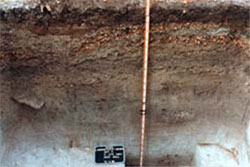
The primary focus of the Environmental Archaeology Program is research into the ancient relationship between people and their environments, including all aspects of that relationship, from the biotic to the abiotic, and from the physical to the symbolic. The Florida Museum EAP researchers and affiliates specialize in the zooarchaeology of vertebrates and invertebrates, macrobotanical analysis particularly of charred and waterlogged plant remains and woods, and archaeopedology, the study of ancient soils from archaeological landscapes.
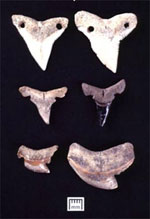
We also study modern specimens for comparative and experimental data. When possible, our projects combine the three components of environmental archaeology to provide a holistic interpretation of ancient environments and cultures.
The Environmental Archaeology Program faculty and staff conduct research primarily in the southeastern United States, the Caribbean, Mexico and Central America, and northwestern South America. Our research is multidisciplinary and international in approach. We have a strong history of collaboration with scientists in natural history, archaeology, and environmental archaeology. Our work is funded by grants, contracts, and private donations. We strive to publish our results in peer review journals and leading technical and public formats. Student researchers gain valuable experience by working with us.
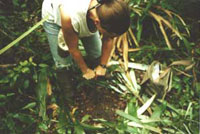
We ensure that our research is within the regional and chronological considerations of the Florida Museum and the Environmental Archaeology team and furthers the research goals of the EA Program either directly or through the accumulation of baseline data. Baseline data is used ensure complete regional coverage and to develop foundations for future research in new areas. In view of our collaborative, interdisciplinary, and integrative work, it is essential that we recognize the importance of acquisition of both data and physical objects. Our policies for EA Program intellectual property ownership and use are based on UF and Florida Museum policy, and on the specific requirements of EA Program research.
Collections-Based Research
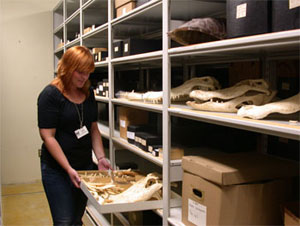
 The EA Program also emphasizes direct research on the modern and archaeological collections. These collections represent a valuable resource for understanding ancient and modern populations and communities, and are far more than a simple analytical tool. In particular, research by Wing over the past 40 years has emphasized gathering specific specimen and environmental data for all modern comparative specimens acquired by the EA Program. Zooarchaeological data on bone, meat, and body weights has allowed the development of formulae for correctly calculating meat contributions based on the archaeological recovery of bony elements. Likewise, Wing has emphasized the importance of allometry as a metric equivalency between element and body size that can be useful for zooarchaeologists. This study requires detailed osteometrics on specific skeletal elements for certain taxa. Standardized data collection methods and techniques have been developed to ensure that this important information is collected each time a specimen enters the collection.
 A second type of EA Program collection-based research is more specifically directed at the development of excellence in basic analytical techniques and tests the efficacy of various archaeological sampling methods and recovery strategies. Fine-gauge sieving has become a standard requirement for zooarchaeological and archaeobotanical analyses, and yet it is still not practiced by all archaeologists. Wing and Quitmyer began generating zooarchaeological data on the utility of this type of sampling years ago and all zooarchaeological analyses in the EA Program continue to gather that data to provide a compelling argument to the archaeologists. Emery and her students continue this research on Mesoamerican archaeological assemblages. As well, over the past decade, Ruhl has compiled archaeobotanical information to evaluate the efficacy of plant recovery strategies at Florida sites by comparing edaphic and other environmental conditions, sample volume, and processing methods with the plant data generated.
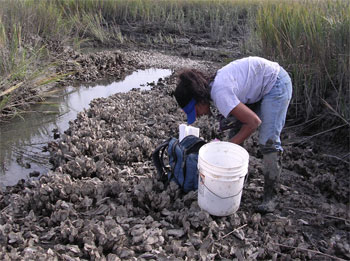 A third category of collection-based research carried out in the EA Program lab augments the archaeological studies and also provides data to other disciplines. Scudder’s analyzed midden soils have provided archaeologically dated, high-phosphorus samples to soil scientists working on the synthesis and survival of phosphorus compounds in natural soils. On-going research by Quitmyer on invertebrate seasonality through annual collection, sectioning, and isotopic testing of modern marine bivalves (sclerochronology) provides important climatological data. Quitmyer’s work (with Franz) on gopher tortoises of the southeastern US added the Holocene gopher tortoise record to that available from the paleontological record, allowing allometric modeling of ancient gopher tortoise body size. Emery’s work on regional distributions of tropical fauna of the Maya forest traces the impact of hunting pressure and habitat change over 4000 years and provides baseline data to conservation biologists working in the area.
Teaching
The Florida Museum is a research college within the University of Florida, and its faculty and staff teach within the various UF departments as a service to the University. Our mission is to interpret our natural and cultural heritage include disseminating that knowledge to the undergraduates and graduate students of UF and other institutions. The Environmental Archaeology Program faculty and staff teach both University of Florida and other students in a variety of ways. We provide a variety of formal courses primarily through the Department of Anthropology of the UF. Zooarchaeology has been taught in the past by Wing, Walker (South Florida Collection Manager and EA Program Affiliate Scientist), and deFrance (Affiliate Associate Curator, EA Program and Associate Professor, UF) and continues to be taught by deFrance (Introduction and Advanced Zooarchaeology).
Both undergraduates and graduate students are also welcomed into the EA Program as interns taking independent study classes, or in paid positions as Federal College Work Study employees or student employees. Any interested student or non-student is welcomed as a volunteer. These are valuable research opportunities contribute to a broad educational experience.
Public Education and Exhibits
Education is not limited to college students and our role as educators is not bounded by the UF campus. Ancient environments can provide important lessons on appropriate strategies for sustainable living, and part of our role is the dissemination of these lessons to the public. As part of this role we welcome visitors and collaborate with K-12 education programs such as those provided by the UF Center for Precollegiate Education and Training. We also assist in the development of exhibits and programs at the Powell Hall Exhibit Center. EA faculty and staff provide public lectures to local schools and various professional and avocational organizations.
Service
The Environmental Archaeology Program provides a variety of services to the Florida Museum, University of Florida, as well as State, National, and International organizations and research institutions of all types. The primary service categories for our work include contract services (for governmental research and private organizations and companies), and professional activities (including service to the Museum, academic professional organizations, and non-academic professional organizations).
Research contracts are particularly valuable for Environmental Archaeology Program research and as a source of funding to support the needs of the laboratory, and educate the next generation of scientists. The EAP provides identification and analysis of archaeological animals, plants, and soils through contracts to private consulting firms, and county, state, and federal agencies involved in environmental and archaeological impact assessment, as well as to educational, avocational, and private organizations.