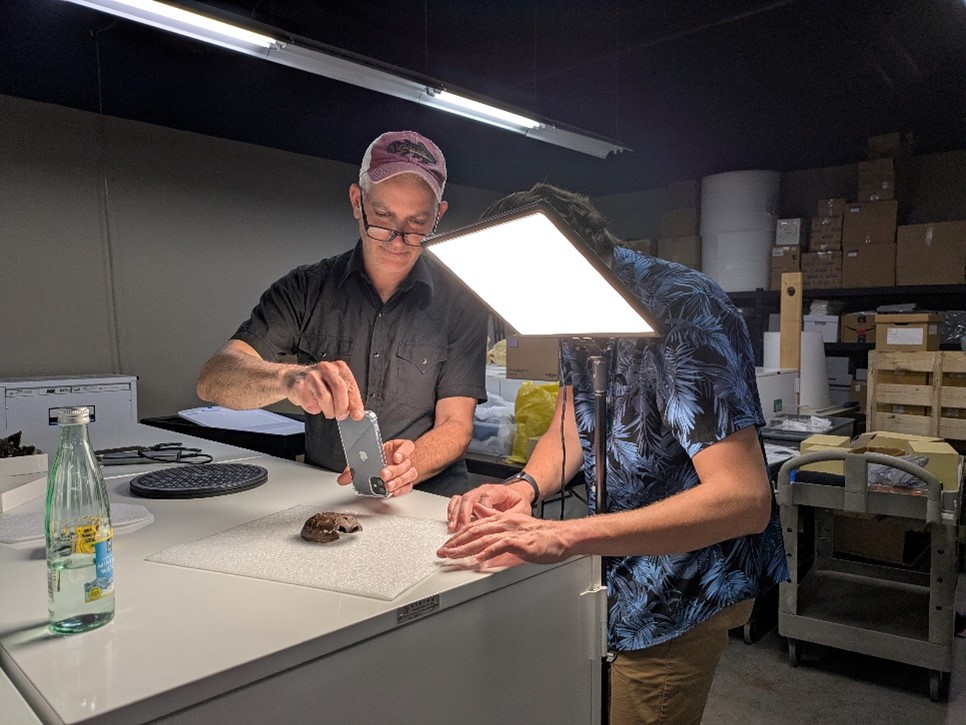
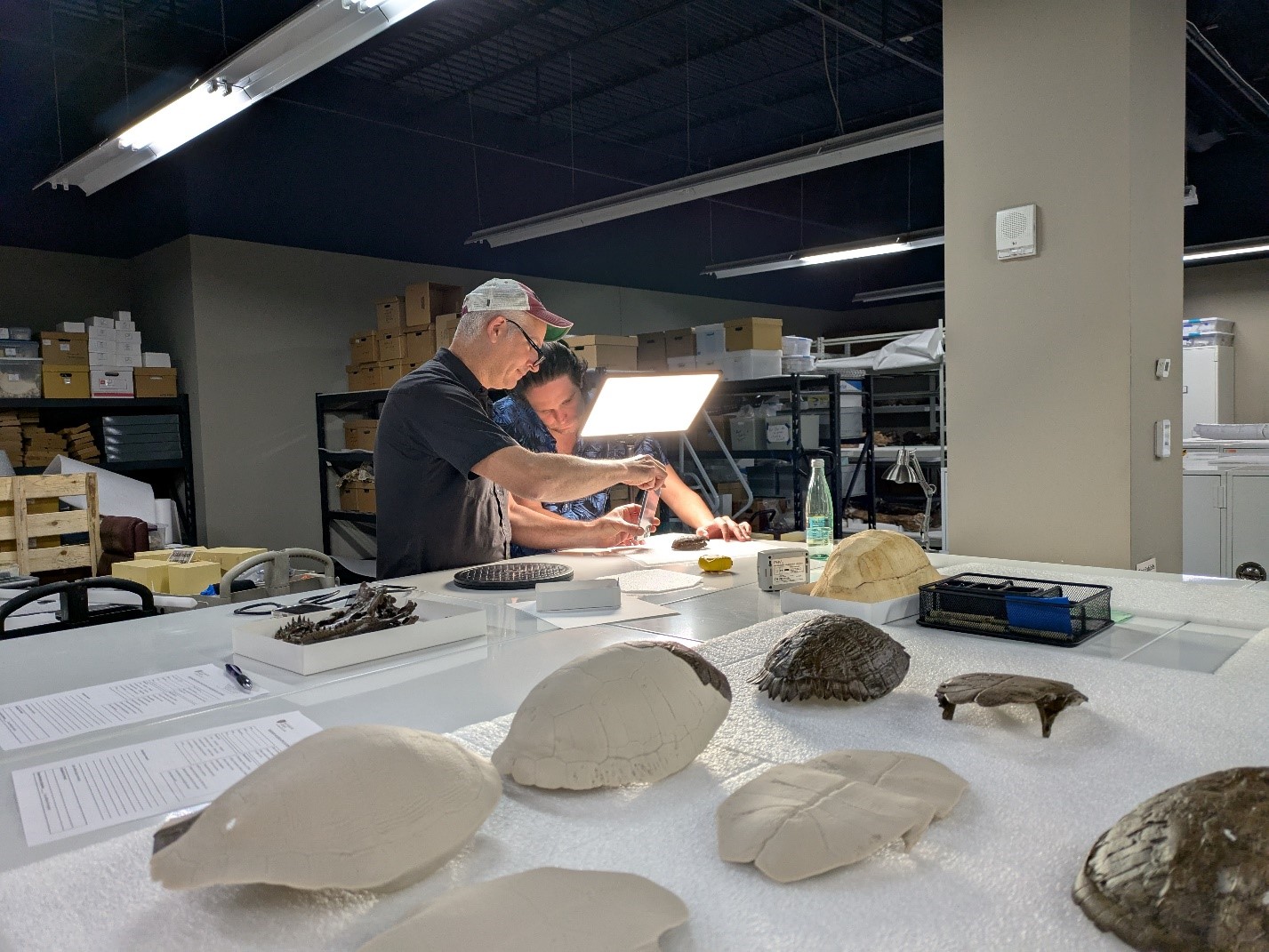
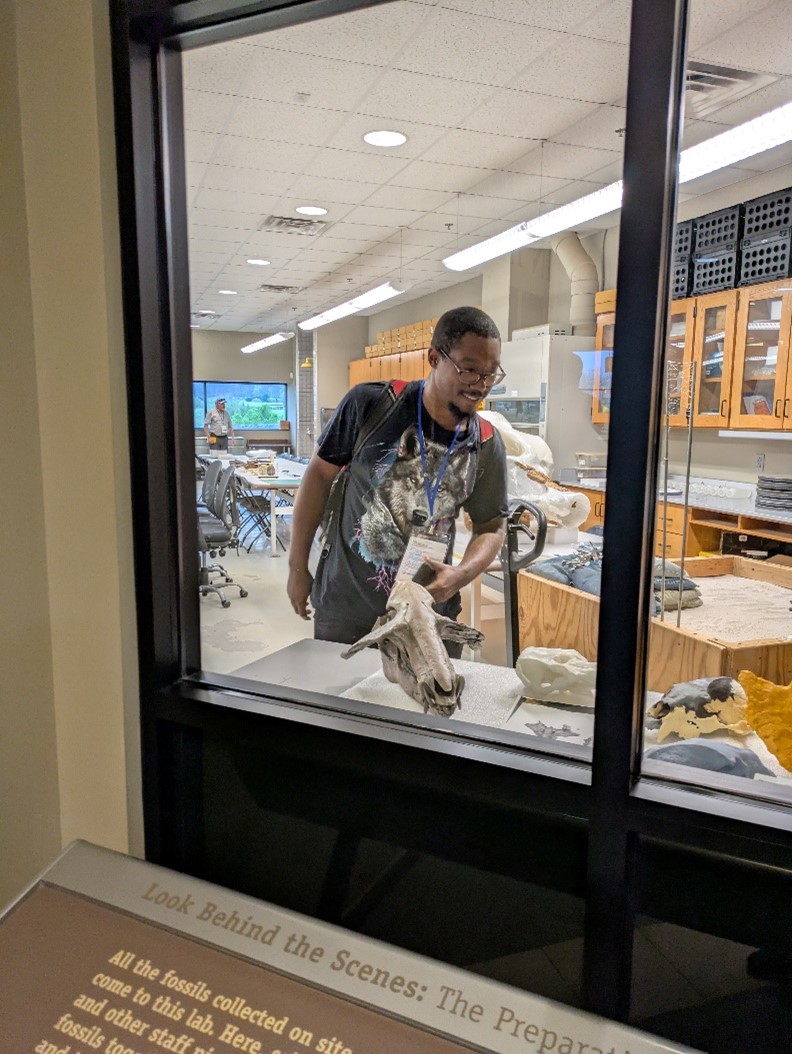
Thanks to the Florida Museum of Natural History Louis C. and Jane Gapenski Endowment, I was awarded funding to attend and present at the annual meeting of the Association for Materials and Methods in Paleontology. This meeting is extremely beneficial for hands-on professional development because the programming builds in a full day of workshops at no additional cost for the attendee. With 10 workshop options available, I chose ‘Basics of Custom Box Construction’, ‘Surveying Fossils’, and the ‘Fossil Collection Tour’.
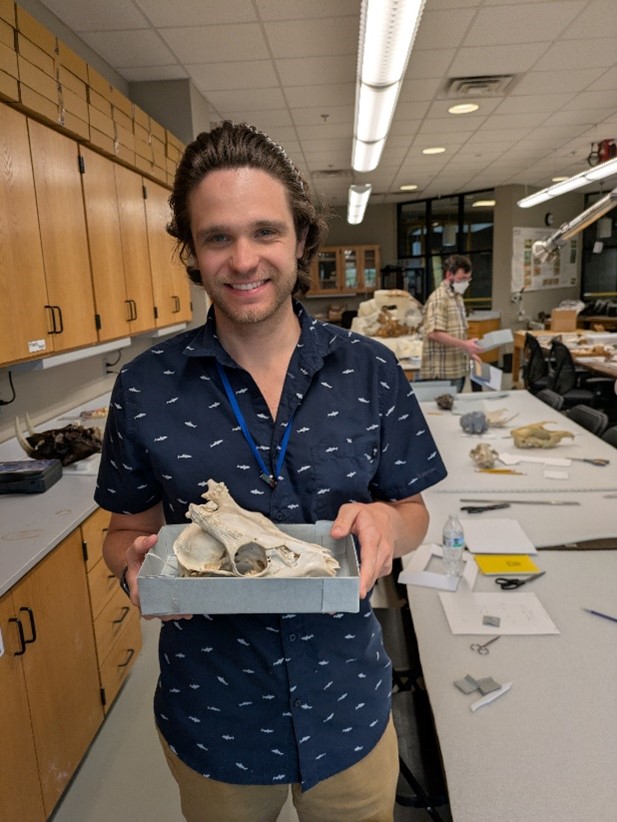
In the ‘Basics of Custom Box Construction’ workshop, I chose a mastodon tooth with a long root and was tasked with working out the best way to store the specimen for maximum longevity. At first, I thought to lay the tooth on its side to minimize the vertical space it would take up. However, the most scientifically important area of a mastodon tooth is the chewing surface. Researchers are most likely to need to take measurements and study the morphology and wear patterns by looking at the chewing surface of the tooth and consider how it would have occluded with the corresponding upper or lower tooth in life. In this case, I created a box which enclosed the tooth on all sides except for the top, where the chewing surface was exposed. One side of the box had ‘wings’ which tucked in but were not glued to provide for an opening like a drawbridge on one side of the box. This would allow a researcher to slide the specimen out and study the chewing surface without having to remove and handle the specimen. Once no longer being studied, the drawbridge closed and the high walls of the specimen box kept it protected in storage from another fossil or edge of a cabinet brushing up against it. This was a very thought-provoking activity and further emphasized to me the importance of storing specimens to keep them safe but usable and not at the expense of saving space, which is always critically low in natural history collections.
The ‘Surveying Fossils’ workshop was eye opening in methods for keeping track of where specimens are removed from in a field site and being able to later look back at the data and consider associations of previously isolated fossils or make inferences about the geology. This workshop physically took place at the Gray Fossil Site which just so happens to be the sister site of our own FLMNH Montbrook Fossil Site. The Gray Site uses a total station to register the coordinates of every single fossil removed from the site. This requires focused effort and more time than our methods at Montbrook, which uses a 1-meter square grid system. It was insightful to see how two very similar sites survey their fossils in such different ways and how those methods correlate with the outcomes and productivity. It would be difficult to backtrack for Montbrook, but I would be very interested in using the total station surveying method for future fossil sites.
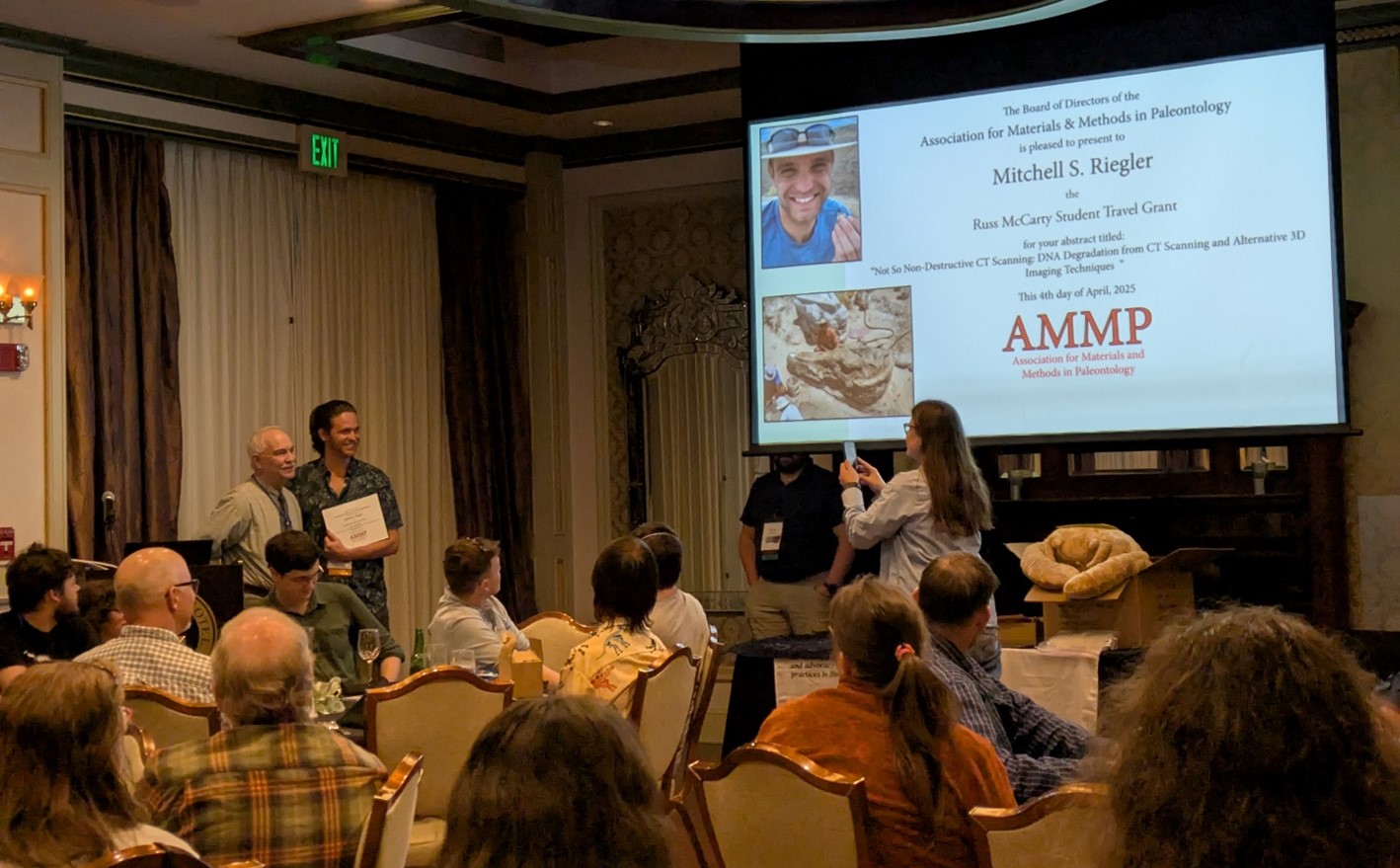
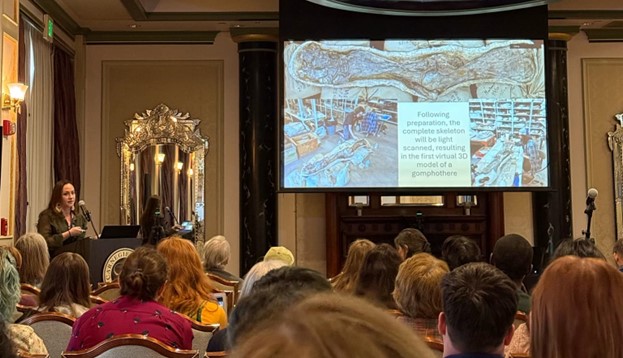
Since the annual meeting took place at our Montbrook sister site, we brought a whole van full of FLMNH Division of Vertebrate Paleontology staff, including the collections managers, fossil preparator, two OPS employees, one graduate student, and one undergraduate student who attended remotely. We drove and roomed together to save costs, brought back ideas about a fossil site comparable to that of Montbrook, developed skills and broadened our understanding of materials and methods in paleontology, and bonded as a team. Our graduate student won the Russ McCarty Student Travel Award during the award ceremony at the conference for his poster presentation, one of our OPS employees gave his first poster presentation at a professional conference, and I presented on the removal of our large adult male gomphothere skeleton from the Montbrook Site. The community of attendees at AMMP provided wonderful feedback for future situations in which we find ourselves needing to remove a very large fossil from sandy sediments. It was a wonderful experience for the entire group, and we are extremely grateful for the funding that allowed us to attend.
Rachel Narducci is a Collections Manager of Vertebrate Paleontology pursuing a Ph.D. through the College of Liberal Arts and Sciences, Department of Biology, advised by Dr. Jonathan Bloch, Department Chair & Curator of Vertebrate Paleontology.
The 2025 Spring CMSS Travel Awards are supported by a combination of the Lawrence Dean Harris & Kathleen A. Deagan Endowment, Mary Ross Endowment, and departmental IDC funds. If you would like to help support these funds for future CMSS awards, please go to:
Lawrence Dean Harris & Kathleen A. Deagan Endowment
Mary Ross Endowment
Natural Science Special Projects and Awards