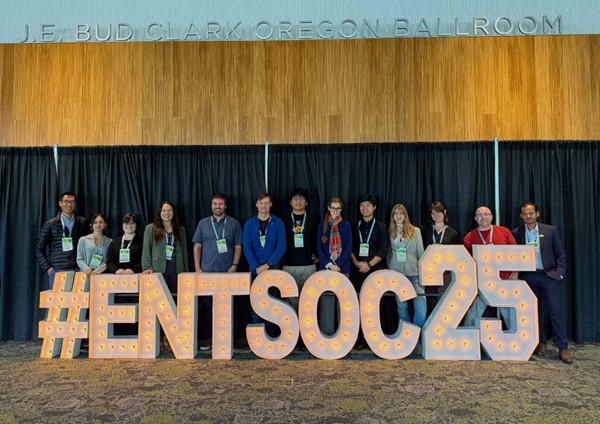
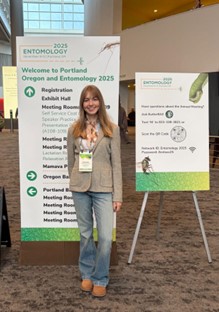
In November, I had the opportunity to attend the Entomological Society of America (ESA) Annual Conference in Portland, Oregon. As the largest organization in the world serving entomologists, ESA brings together researchers, students, and professionals from a wide range of disciplines. This was my first scientific conference, and being surrounded by so many people who share a passion for insects and biodiversity was both exciting and motivating.
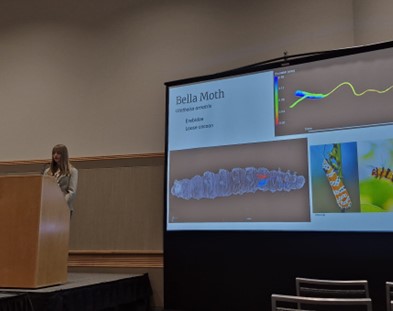
I participated in the Undergraduate 10-Minute Presentation student competition in the Systematics, Evolution, and Biodiversity (Systematics and Morphology) category. Presenting my research to an audience of peers and experts pushed me to clearly and concisely communicate my work, while also helping me grow as a presenter. I was honored to receive second place for my presentation, which gave me a huge confidence boost and reinforced my interest in continuing research in ecology, conservation, and evolutionary biology.
Beyond presenting, the conference allowed me to attend talks and poster sessions on a wide range of topics and to connect with researchers at different stages of their careers. I learned about new approaches in entomology and biodiversity research and gained a deeper appreciation for how collaborative and interconnected scientific research really is. These conversations and experiences helped me think more intentionally about my future goals and how I want to contribute to the field.
This experience was also an opportunity to represent the University of Florida and the Florida Museum of Natural History at a national scientific meeting. The training, mentorship, and research opportunities I have received through UF and the museum prepared me to share my work in a professional setting and engage with the broader scientific community. Attending ESA allowed me to bring visibility to the work being done at UF while also bringing back new ideas and perspectives that will inform my future research within the museum.
I would not have been able to attend this conference without the support of the Louis C. and Jane Gapenski Endowment and the 1923 Fund, and I am extremely grateful for this opportunity. This experience not only expanded my professional network but also improved my scientific communication skills, reinforcing my passion for research and my commitment to contributing to the study of biodiversity. I left the conference feeling motivated, inspired, and excited to continue growing as a scientist.
Anastasia Baluk Garavaglia is an undergraduate student at UF working in The Kawahara Lab as an undergraduate Museum Intern, advised by Dr. Akito Kawahara, Director of the McGuire Center Lepidoptera and Biodiversity and Curator at the Florida Natural History Museum.
The 2025 Fall Student Travel Awards are supported by the FLMNH Department of Natural History, including funds from the Louis C. and Jane Gapenski Endowed Fellowship. If you would like to help support this fund for future student awards, please go to: