Background
The Floridan aquifer is a network of underground porous rock that contains the primary source of drinking water for about 10 million people. In some areas, the aquifer is susceptible to pollutants such as excess nutrient or fertilizer runoff and saltwater intrusion. This is due to it being “unconfined” or having limited thickness of rock between the aquifer and the surface. Overexploitation is another threat to the aquifer, and its overuse will limit future reserves and its overall health and longevity.
The Upper Floridan Aquifer (UFA) is responsible for creating 824 of our iconic springs across Florida, Georgia, and Alabama. Thirty-three of these are classified as first magnitude springs, meaning that they discharge over 64.6 million gallons per day.
The Floridan aquifer supplies the drinking water and beloved ecosystem for millions of Florida residents. As human exploitation threatens the health and sustainability of this resource, it is imperative to understand the real-life implications of a management plan to conserve this resource.
Current Research
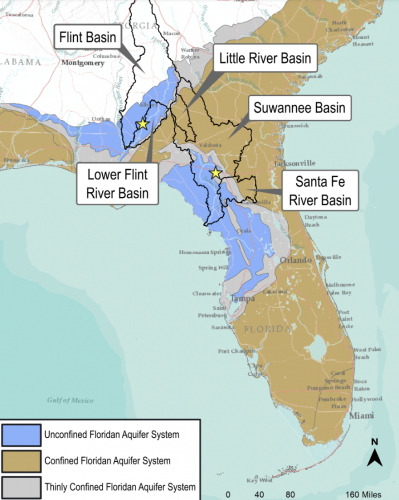
This study was part of a larger project — the Floridan Aquifer Collaborative Engagement for Sustainability (FACETS) project — and investigated how the public values a hypothetical Best Management Practices incentive program designed to conserve the Upper Floridan Aquifer. This management plan includes limiting nutrients and water usage in agriculture applications and using strategic timing and amounts of fertilizer and irrigation. This study investigates if the public would be willing to provide a monetary incentive for farmers who limit their water usage but face potential decreases in crop yield. The lead researcher, Dr. Kotryna Klizentyte of the UF School of Forest, Fisheries, and Geomatics Sciences (SFFGS) and UF Water Institute affiliate, asked three main questions in this study:
- How much are people willing to pay for a program that helps protect the aquifer?
- What specific benefits (like cleaner water or providing financial help for local farmers) are most important to them?
- Does the way you talk about the problem (using moral language like “fairness” or “loyalty”) change people’s support?
Dr. Klizentyte and her team used several social science methods to answer these questions. These included discrete choice experiments, latent class analysis, and problem framing experiments. This means that researchers asked people to choose between different options to see what they value most, grouped participants by similar preferences, and tested whether changing how the issue was described affected support for the program, respectively.
The key findings from the study showed that the participants had the highest willingness to pay for benefits that directly impact people. Individuals were willing to pay an average of $104.75 for increased water quantity and longevity for public use. The study also investigated agricultural practices to support farmers who might be impacted by a change due to their dependence on water from the aquifer. Individuals were willing to pay an average of $129.65 to support farmers and producers with increased jobs and financial stability.
The researchers also presented the management plan in a way that framed the issue using themes of fairness and loyalty. This led to an increase in participant engagement; however, it reduced the willingness to pay across all plan topics compared to the neutral control group. This means that policymakers and communicators need to balance engagement and willingness to pay. If the goal is funding, a neutral, practical framing may work better. If the goal is broad awareness and participation, moral framing could be useful.
Finally, the study highlighted that a single communication strategy will not work for everyone. The message that goes out to farmers about this management plan must be different from the message that goes out to the public, to ensure that each unique audience will see the benefits and encourage support for this policy.
Why it matters
From the results of the study, researchers are able to determine that the public strongly supports conserving the aquifer resources, especially when the program also supports local farmers and ensures water availability in the future.
To achieve an effective plan that both the public and farmers support, it is important to find the right communication strategy. Studies like these can gauge public perceptions of these topics and allow policymakers and resource managers to apply the findings to their work. Scientific studies have already found that the Floridan aquifer is struggling from nutrient pollution and overexploitation. A management plan is needed to meet these issues, and that won’t be possible without the support and cooperation of the public and agricultural producers.
Learn more about Dr. Klizentyte’s research here or contact her at kklizentyte@ufl.edu. Other researchers on the team: Dr. John Lai of UF Food and Resource Economics Department, Dr. Sadie Hundemer of UF Department of Agricultural Education and Communication, Dr. Andres Susaeta of Oregon State University, and Dr. Damian Adams of UF SFFGS. You can also learn more about the FACETS project here and the wider effort to promote economic and environmental sustainability of agriculture and silviculture in the Suwannee River Basin.