Learn about the current research at UF around PFAS contaminants or “forever chemicals” in our drinking water. Ryan Gains, an environmental engineering doctoral student shares his innovative approach to PFAS absorption and removal using nanotechnology.
Background
PFAS or “forever chemicals” have been as prevalent in our news headlines as our drinking water. As we understand more about the harmful substances and their sources, we also begin to understand methods of removal from our ecosystems and ourselves
PFAS has been used since the early 1950s, from food packaging to fire resistant foam, the non-stick chemical is certifiably multi-purpose. Because of their chemical structure, PFAS do not degrade easily. In fact, some PFAS have unknown rates of degradation, meaning that they will persist in our bodies and environment for potentially thousands of years.

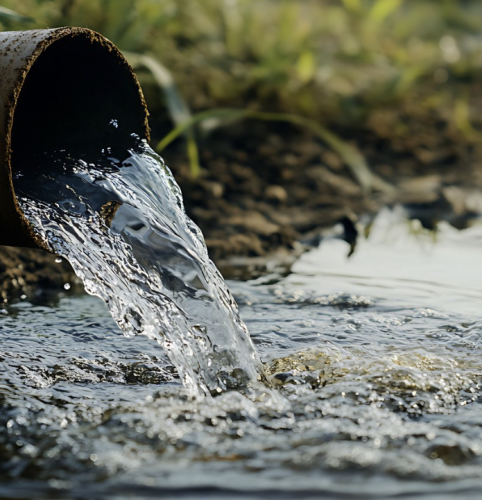
A big issue involves our wastewater. Because PFAS are in so many of our everyday appliances and industries use these chemicals on such a large scale, when we inevitably dispose of these materials, they go into our sewage system for processing. Our wastewater, although heavily treated, is still not useable for drinking water, but it is applied to agricultural lands and kept in water retention ponds. With Florida’s soil composition, it is easy for that water to seep into our ground and drinking water, bringing all those harmful contaminants with it.
Current Research
To tackle this emerging and prevalent problem, Ryan Gains, an environmental engineering doctoral student at the University of Florida, and his team are working on several successful and cost-effective methods to absorb and degrade the PFAS contaminants from the water and make it much safer for our personal and environmental health.
The technology that Ryan and his team are investigating is the use of “Carbon-Dots” (CDs) which are a form of nanotechnology. These CDs will absorb PFAS and reduce the overall saturation of them in our water.
Additionally, they are looking at a technology called “nonthermal plasma” (NTP) which can effectively break down the PFAS itself, removing it from the environment entirely.
NTP is particularly useful for breaking down “long-chain” PFAS, but further research is underway to identify methods of removing all types of PFAS.
According to the National Institute of Health (NIH), there are over 15,000 types of PFAS contaminants identified, so identifying a universal PFAS remover is not within the scope of our available research yet.
Why it matters
 Ryan’s research is just one of many current UF projects, working to identify a solution to this environmental and human health problem. His research brings a multidisciplinary approach to previous research making the use of these CDs and NTP more cost-efficient and adoptable.
In the future, we hope to apply these innovations around Florida to mitigate the effects and presence of PFAS in our drinking water.
You can find more information about Ryan’s research here and contact him at ryangains@ufl.edu.
Information from EPA, NIH, and UF College of Veterinary Medicine.