Background
Every year, innovative technologies are created to combat pressing environmental and public health problems, from fire-fighting foam to pesticides to limit Malaria. However, many of these technologies contain chemicals whose widespread use can lead to environmental and human health problems.
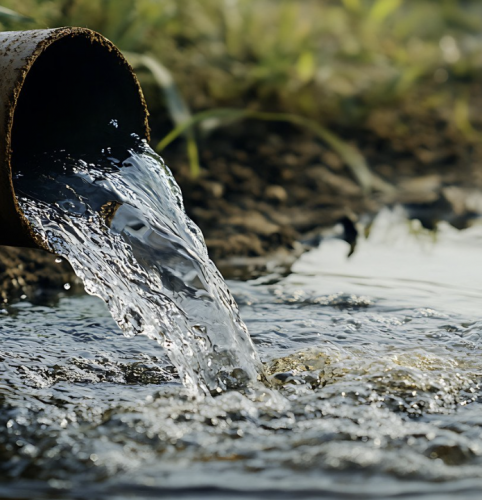
As we apply these chemicals to land and infrastructure, they eventually make their way back into the water ecosystem through runoff or the wastewater treatment process.
One of today’s widespread contaminants are called PFAS, or per- and polyfluoroalkyl substances. Used since the 1950s, they are found in the coating of our non-stick pans, food packaging, cosmetics, and more.
Unfortunately, PFAS are contaminants linked to cancer, infertility, and other harmful human and environmental health impacts. How widespread they are in our environment makes them particularly concerning. Around 50% of the rivers and streams in the US have been contaminated with PFAS, and 98% of the US population has them in their blood.
When discussing our sewage system and wastewater treatment, PFAS have been particularly relevant. PFAS are found in high concentrations in our waste, and despite extensive treatment and filtration, they remain present in the reclaimed water that is produced.
Current Research
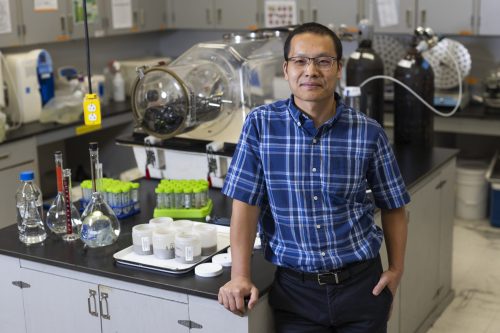 Dr. Dengjun “Kevin” Wang is an assistant professor in the Department of Agricultural and Biological Engineering of UF/IFAS.
His research focuses on emerging contaminants like PFAS. He is working to understand how these pollutants move and change the environment and what happens to them over time. Then he develops engineered solutions to try to mitigate or control the impacts of these pollutants in our water, soil, and the land. Some of these include the use of nanotechnology and biochar.
“We conduct laboratory studies and field samplings,” he said. “We use different modeling [tools] to try to simulate how those contaminants move in the environment.”
Because PFAS are such a widespread issue, Dr. Wang works with collaborators across the country.
In Florida, there is a particular risk partially because of our state’s soil structure. “[There is] sandy soil in Florida and the PFAS can easily leach down to the groundwater as sandy soil has limited capability to immobilize PFAS,” he discussed, “a large portion of groundwater in Florida will be used as the drinking water source.”
Why it matters

Similar to PFAS, DDT and PCB were popular products that caused environmental harm and are a historical reminder of the dangers of unresearched chemical applications. DDT and PCBs are now banned, but PFAS now highlight the need for better precautions,
DDT (dichloro-diphenyl-trichloroethane) was widely used on crops to fight malaria in the 1940s. It was later banned in 1972 after being linked to reproductive harm and cancer.
PCBs (polychlorinated biphenyls) were used in industrial products like paints and plastics. They were banned in 1979 due to health risks including cancer and immune, reproductive, and neurological damage.
Dr. Wang hopes to see future regulation from the USDA for these types of harmful contaminants. “Every 5-10 years, we will see a new emerging contaminant popping up,” he said, “before we start to produce those things at large scale in the future, [we must conduct] more a thorough evaluation on the toxicity and human health risk to see whether that product cannot be the next PFAS, the next DDT, or the next PCB.”