David Tegeder, co-author of Ditch of Dreams: The Cross Florida Barge Canal and the Struggle for Florida’s Future, explained, “As a result of a threat to the aquifer, issues of saltwater intrusion, there will be a turn towards creating a barge canal”—a project that ultimately was never completed.
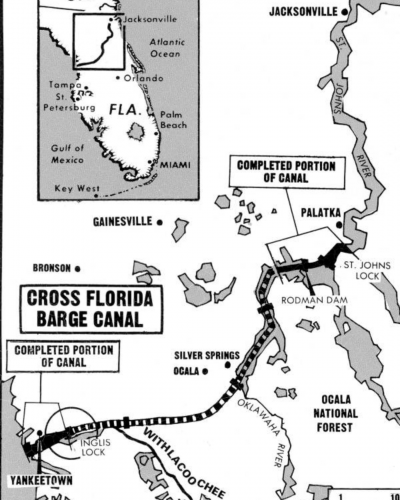 Caption: A map showing the canal as it was envisioned compared to the limited progress that was made.
What is it?
The Cross Florida Barge Canal was a large-scale construction project designed to link the Gulf with the Atlantic Ocean. It would have connected a patchwork of rivers, lakes, and waterways across Florida, using a series of locks and dams. The project promised to shorten shipping routes by about three days, as ships could bypass the long journey around the state’s peninsula.
Business leaders saw the canal as a major opportunity for overseas trade and transportation efficiency. By opening Florida’s interior to shipping, the canal was expected to stimulate economic growth and strengthen the state’s role in commerce.
Why it happened:
The idea for a canal across Florida dates to the 16th century, when Spanish explorers recognized how the peninsula posed a barrier to trade. Over the centuries, the concept resurfaced as trade demands and shipping technology grew.
In the 1930s, President Franklin Roosevelt’s New Deal provided funding to begin the project. At the time, the canal was intended to employ workers during the Great Depression while also improving U.S. infrastructure. However, after three years of work, funding ran out, and construction stalled. Critics pointed to potential harm to Florida’s water systems, including saltwater intrusion into the aquifer, while others argued it was too costly and offered little benefit to non-Floridians.
The project was revived in 1964 when President Lyndon Johnson authorized new federal funding. Advocates justified construction by pointing to job creation and even national defense. Despite this momentum, environmental concerns gained traction. By 1971, President Richard Nixon permanently halted construction, citing the ecological damage the canal would cause. At that point, the project was only 28% complete, with $75 million already invested.
Where is it now?
Though the canal was never finished, the land set aside for it did not go to waste. The abandoned corridor became the Marjorie Harris Carr Cross Florida Greenway, named after the activist who helped stop the project.
Today, the Greenway stretches more than 70,000 acres across 110 miles of central Florida. It contains over 300 miles of trails for hiking, biking, and horseback riding. Beyond recreation, the Greenway is also a crucial wildlife corridor, serving as a refuge for animals such as black bears.
A landmark feature of the Greenway is the Cross Florida Greenway Overpass, the state’s first “land bridge.” Located along Interstate 75, the bridge allows both hikers on the Florida Trail and wildlife to cross safely, symbolizing the transformation of a failed industrial project into a celebrated conservation and recreation space.
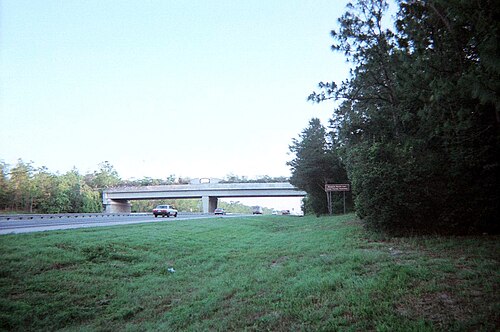 Caption: The Marjorie Harris Carr Cross Florida Greenway Land Bridge—cars speed by below while wildlife and hikers cross safely above.
Information from The Florida Historical Society, U.S. Fish and Wildlife Service, and Florida State Parks. First photo by The Florida Historical Society. Second photo from DanTD (CC BY-SA 3.0).