“Pine rockland forests are like biological lifeboats carrying a precious crew of rare and endangered species into the future.” – Elise Bennet, Center for Biological Diversity
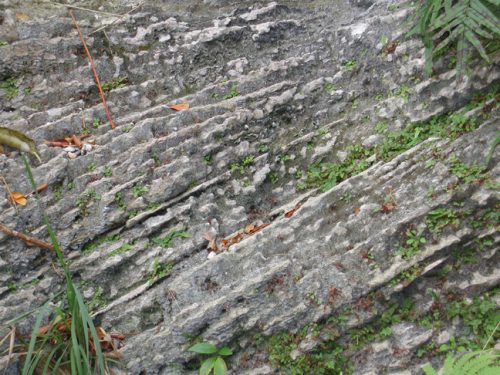 A Miami Limestone formation, with parallel inclined layers, demonstrating the geological exposure to natural forces by weathering over time.
What is it?
Miami Limestone, formerly called Miami Oolite, is the bedrock beneath much of South Florida, including the Atlantic Coastal Ridge, Florida Bay, and the land east of Everglades National Park. It formed about 130,000 years ago during the Pleistocene, a warm period when the ocean covered parts of Florida. Alongside the Anastasia Formation to the north and the Key Largo Limestone to the south, it is one of three major limestone formations in the region.
In shallow seas, tiny grains of sand and shell were coated in calcium carbonate—the same material found in seashells—forming small spheres called ooids. Ocean currents gathered these ooids into large deposits, and over time they hardened into the rock we now call Miami Limestone.
This limestone is usually soft and white, with inclined parallel layers that can reach 12 to 50 feet thick. Where exposed, the surface appears sharp and glassy but breaks easily because of centuries of flooding, rainfall, and erosion.
How it happened:
Uranium-series dating confirms that Miami Limestone formed during high sea levels in the Pleistocene. Later, when sea levels dropped during the Wisconsian glaciation, parts of the rock were exposed to air. Rainwater seeped into the porous ooids, leaving behind additional calcium carbonate that cemented the grains together into hardened stone.
These sea-level changes also shaped ecosystems. For example, pine rocklands now grow on exposed limestone ridges, and periodic fires help maintain these rare habitats.
Where is it now?
Today, Miami Limestone continues to shape the ecosystems and water systems of South Florida. Its porous structure supports aquifers and influences how water moves through the Everglades and nearby wetlands. Exposed outcrops remain visible in areas untouched by development, especially within pine rocklands.
Like the Everglades itself, this limestone foundation is fragile. Human development, quarrying, and changes to water flow threaten its natural integrity. Still, understanding Miami Limestone is essential—it is more than just rock beneath our feet; it is the stage on which South Florida’s ecosystems, from the Everglades to Florida Bay, depend.
Information from the U.S. National Park Service, Florida Atlantic University Department of Geosciences, UF Biodiversity Institute, Wisconsin Geological and Natural History Survey, National Geographic Education, The Invading Sea, Science Direct, and U.S. Geological Survey. Photo by Florida Atlantic University Department of Geosciences.