This summer, a group of Oak Hammock residents took on a six-week challenge: to turn environmental ideas into actionable projects through the Community Action Projects for the Environment (CAPE) curriculum. Led by The CLEO Institute in partnership with the Florida Museum’s Thompson Earth Systems Institute (TESI), the program concluded on August 6, 2025 with participants energized to keep the work going.
“This is a residential community full of active, thoughtful elders who have made career contributions in a variety of different ways,” said facilitator Martha Monroe, UF Professor Emeritus, Environmental Education. “They brought their experience and wisdom to the task and worked together to develop requests for change.”
 Participants formed four project teams, each focusing on a key area of sustainability at Oak Hammock: knowledge of the Florida springs, landscaping, food waste, and energy. Over the course of the program, these groups researched their topics, identified actionable steps, and prepared compelling requests.
The Springs group proposed that Oak Hammock’s Institute for Learning in Retirement (ILR) offer a course focused on Florida’s regional springs, which is now in development. The Energy group advocated for solar panels to be installed as part of the construction of Building 3, The Canopy. The team’s first step is to work with Gainesville Regional Utilities to ensure approval for the project.
The Landscaping group recommended exploring the types of pesticides and fertilizers currently used on Oak Hammock grounds, with the goal of identifying options that are safer, more cost-effective, and equally efficient. Their ultimate vision is to earn Audubon certification for the property.
The Food Waste group outlined a series of steps to reduce waste in the community’s dining facility, starting with a thorough assessment and moving toward offering non-plastic to-go containers as a more sustainable alternative.
The final session served as a rehearsal for presenting these “asks,” with invited guests offering constructive feedback. Among them was Oak Hammock CEO Kevin Ahmadi, who answered questions and shared his perspective on their ideas, ensuring they were grounded in both vision and practicality.
“It was nice to interact with like-minded people and exchange ideas,” said attendee Diana Shamis. Others noted that the process rekindled their sense of collective action. “Collaboration… is very effective,” shared participant Jeff Shamis.
For many, the experience deepened local connections. “This was a different way to meet and work with people, and to know and meet some new people. I just loved that,” said Barbara Rothstein. Pam Jones-Morton expressed hope for Oak Hammock’s future: “We have to be able to show [future residents] that this community takes the environment and climate change seriously.”
Facilitator Ellen Siegel, The CLEO Institute Climate Speaker Specialist, was struck by the persistence and dedication of the participants. “Almost everyone who started, finished,” she said. “The emergence of strong internal leadership in each group confirmed that this model can thrive in this kind of setting.”
TESI Director and Associate Curator of Museum Education Megan Ennes noted that the program sparked new opportunities, including a planned October presentation featuring TESI’s community outreach activities and a seminar series on Florida’s springs in Spring 2026 for Oak Hammock’s ILR. “We are excited to see the results showing that confidence improved following the curriculum and that our participants are dedicated to continue engaging in this work,” Ennes said.
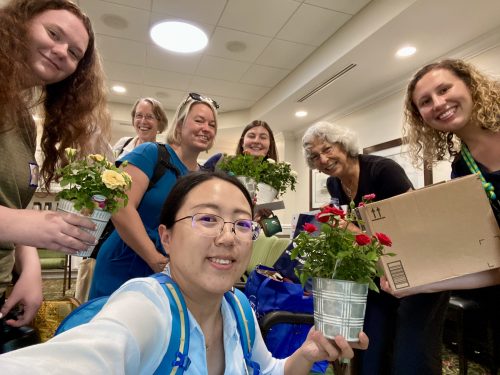
Facilitator, Yue Li, UF Assistant Professor, School of Forest, Fisheries, and Geomatics Sciences, was inspired by participants’ thoughtful discussions that led to meaningful action plans for their community: “They are thought leaders and pioneers who will act beyond what they proposed during this project and influence other residents to take action”.
The planning team also included Gabi Sullivan, a graduate assistant, Erin Stolen and Elle Henson, undergraduate assistants.
With helpful facilitation, enduring enthusiasm, and a shared commitment to environmental stewardship, the Oak Hammock CAPE pilot proved that community action has no age limit and plenty of room to grow.
photos by Carla Ruffer and Yue Li