Did you know you can participate in research for citizen science that requires no equipment setup or experience? It’s true! With online platforms for surveying camera traps, you can be a part of data collection and share stories of wildlife with others.
What is a camera trap?
A camera trap is a digital camera that turns on when it gets a signal from its infrared sensor. If the sensor “sees” moving objects that project heat, like animals, the camera records an image or video. This content is saved on a memory card.
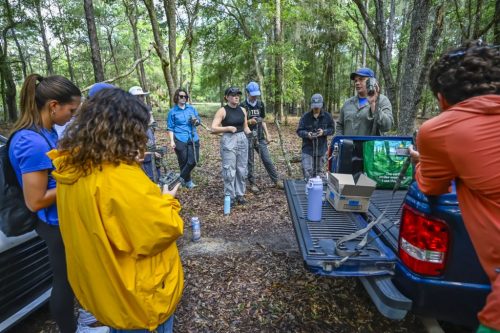
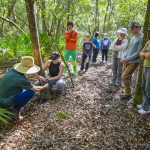
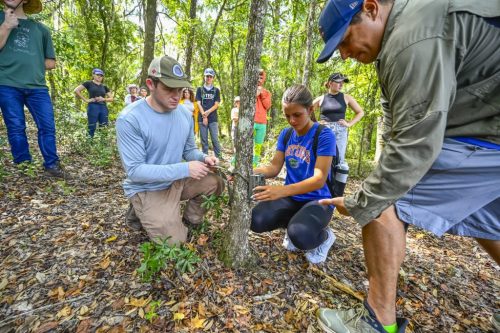 Caption: Thompson Earth Systems Institute Environmental Leader Fellows learned how to program and place camera traps at the Ordway-Swisher Biological Station with Dr. Matt Hallett, Assistant Professor in Wildlife Ecology and Conservation, last month.
Why are they important?
Camera traps can be left unattended and can watch an area of habitat for a prolonged period of time, usually many weeks or months. This allows them to discreetly monitor an area of habitat and record rare events in nature that would otherwise go unnoticed.
Camera traps also help us understand the interactions between humans and livestock as well as provide data on population sizes and species location. Plus, a remote camera increases the potential for more biodiversity data.
How to get started:
Zooniverse and Wildlife Insights are great starting points for anyone interested in citizen science. These beginner-friendly platforms make it easy to participate in real research projects—no experience or special equipment required. Both sites offer opportunities to explore and contribute to camera trapping and other types of scientific data collection from anywhere.
Getting started is simple:
- Create a free account using your email address.
- Browse dozens of available projects covering topics like astronomy, wildlife, climate science, and history.
- Follow the short tutorial provided for your project of interest.
- Help classify data—such as identifying animals in camera trap photos, sorting galaxies, or transcribing historical documents.
- Join project discussion boards to connect with researchers and other volunteers. Many exciting discoveries have come from these collaborations!
Whether you spend a few minutes or make it part of your routine, your contributions support scientists and help advance discovery around the world.
Information from the UF Biodiversity Institute, Zooniverse, Wildlife Insights, the National Science Teaching Association, the UF Thompson Earth Systems Institute, and the World Wildlife Fund. Photos from Jeff Gage of the Florida Museum of Natural History.