 Research
At the Del-Rio lab, we aim to understand the evolutionary processes responsible for the formation and maintenance of biological diversity. Together, we investigate the genomic mechanisms that drive speciation and phenotypic differentiation at both microevolutionary and macroevolutionary scales in birds.
Our research questions and datasets stem from collecting specimens in the field, quantifying phenotypic variation, and gathering genomic data from vouchered specimens in the laboratory. Ultimately, our goal is to uncover the molecular and cellular mechanisms behind the formation of different bird species.
Check out some of our projects:
Genomics of speciation in Amazonian hybrid zones
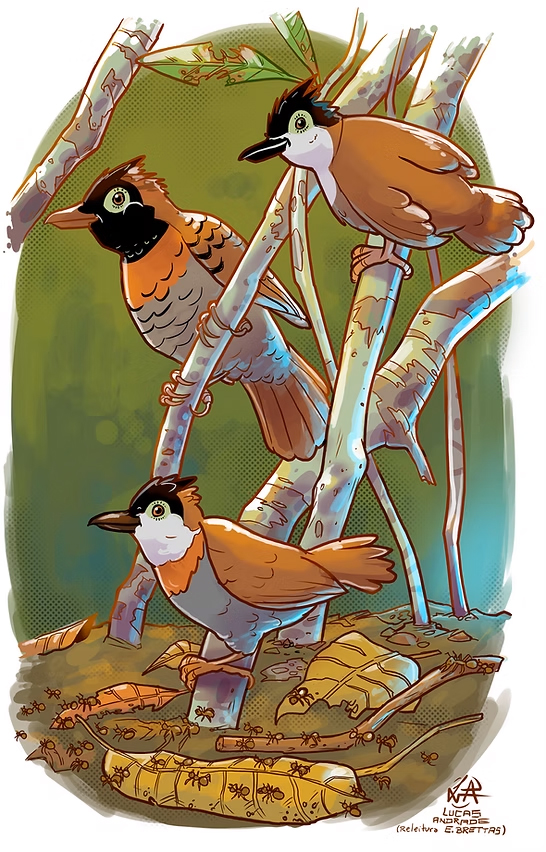
One of the main systems studied in our lab is a hybrid zone between two Amazonian birds, the White-breasted Antbird (Rhegmatorhina hoffmannsi) and the Harlequin Antbird (R. berlepschi). These birds are obligate army-ant followers. As Army-ants send out huge raiding parties that flush roaches, spiders, and other arthropods from the leaf litter, Rhegmatorhina forages above the ant swarms capturing the exposed large arthropods and even small vertebrates. Besides being super cool birds, the hybridizing Rhegmatorhina provide a unique natural system for the study of how new species arise and are maintained. Using morphological data, whole genomes and functional tests, we try to which are the reproductive isolating mechanisms preventing these two species from fusing into a single one. Besides Rhegmatorhina, many other bird Stay tuned to upcoming publications with phenotype-genotype functional tests in cell cultures!
Amazonian rivers as barriers for birds
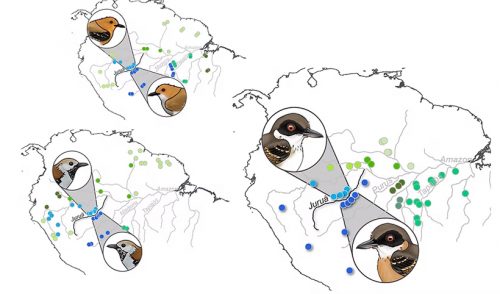
In 2019, I decided to pay a tribute to Emilie Snethlage, by making an all-women expedition to the Amazon Forest. We chose to sample the Juruá River area, because that was a frontier in Amazonian ornithology and the only river never visited by Emilie Snethlage. In a team with 9 women biologists, we gathered an extensive collection for the area and came to the realization that a few species pairs would replace each other on opposite river banks. This result was unexpected, because the Juruá is quite narrow and super dynamic. Our preliminary data suggest that the wide seasonally flooded forest of the Juruá plays an important role on preventing that some birds, from the forest interior, would cross the river. Today, Marky Mutchler and I are working together on gathering genomic data (ultra conserved elements) to better understand population genetics and phylogeographic patterns of four species complexes from the Juruá region. The Emilie Snethlage Expedition would not be possible without the support of our amazing donors! Thank you very much!
Amazonian suture zones
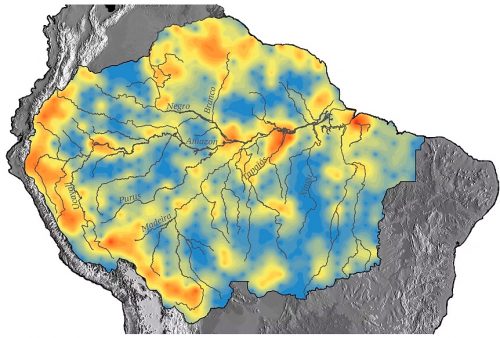
Since 2015, I am a collaborator (second author) in a project in which we are mapping the distribution of all Amazonian bird taxa, including species and subspecies. 80% of our ~620,000 point localities were obtained from museum specimens housed in 30 museum collections in Europe, South and North America. We are using this huge dataset to assess the: (1) locations of bird suture zones across the Amazonian landscape; (2) relative importance of geographic barriers for birds; (3) gaps in the ornithological knowledge and sampling effort; (4) composition of areas of endemism; (5) habitat loss of Amazonian birds in face of deforestation and climate change. In 2021, our talk on Amazonian suture zones was awarded with the AOS (American Ornithological Society A. Brazier Howell) Award given for the best presentation on any topic in ornithology! Stay tuned for our upcoming publications!