Through onsite initiatives like Junior Science Academy and K-12 field trips to the Museum, and offsite programs like Museum on the Move, Youth Teaching Youth, and Teaching Toolboxes, the Natural History Museum of Utah (NHMU) has statewide saturation reaching almost 70,000 students annually.
All of these programs are designed to directly complement the Utah State Science Core Curriculum standards. In addition, our paleontological researchers have partnered with Grand Staircase-Escalante National Monument for the past fourteen years to bring world renowned paleontological discoveries to Museum visitors and K-12 students through engaging Museum exhibits and outreach materials. Nonetheless, despite the NHMU’s extensive programming, many school districts statewide remain underserved, largely because they lack the financial resources for field trips to the Museum or field sites. These students are at a major disadvantage because they are not afforded the opportunities to interact with real objects (i.e., scientific specimens such as rocks, minerals, fossils, etc).
ROCKS, or Real Opportunities to Connect Kids with Scientists, aims to bring paleontology to life by bringing K-12 students into the field and behind the scenes at the Museum by providing them the opportunity to explore right alongside scientists through a digital experience, as well as the chance to interact with Museum educators and scientists while observing real fossils.
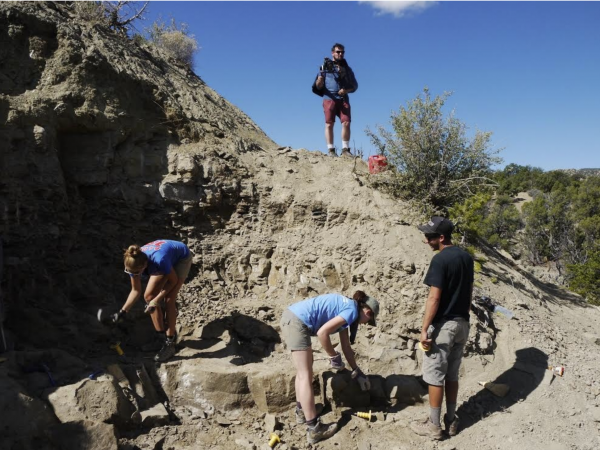
The first component of ROCKS is a suite of videos that encourage students to use the scientific process to explore the world of paleontology. By using paleontology as a lens we are able to provide an engaging venue for students to develop and hone their science process skills, while at the same time aligning with the Intended Learning Outcomes found within the 4th Grade Utah State Core Curriculum.
These videos provide the student with the opportunity to follow a fossil’s journey from when it was discovered at a field site, to when it is prepared in the lab, and finally, when it is cataloged in collections; these videos also allow for background for a subsequent live Skype-interactive with a Museum paleontologist. After students have viewed the videos, Museum educators will visit each classroom and facilitate various hands on, inquiry-based activities with museum quality specimens that further support the exploration process and provide fodder for further questions and inferences. Thereafter, students will have the opportunity to ask their questions and share their discoveries over Skype with a paleontologist from the Museum.
Once students have built a solid foundation of scientific process skills via the pre-recorded videos, hands-on experiences with the fossils, and interactive Skype conversations, the students will visit the Museum to have a first-hand look at paleontological specimens in collections, and interact in person with the paleontologist they previously conversed with virtually.
For the first year of this project, we are targeting all 4th grade teachers and students in an underserved school on the west side of Salt Lake City (approximately 100 students and 4 teachers), but plan on expanding the reach and scientific breadth of the program in future years. The prerecorded videos will also be placed on the Museum website alongside additional resources and be made available to all K-12 teachers. The education philosophy of the Natural History Museum of Utah has always been to encourage students to feel comfortable utilizing science process skills and, in turn, discovering their true abilities as scientists. We are guided by the emphasis that the scientific process is not a prescriptive method; instead, it is an array of tools that can be adapted for use in a variety of scientific settings.
By the end of the experience students will be able to:
1) use science process and thinking skills;
2) manifest science interest and attitudes;
3) understand important paleontological concepts and principles;
4) communicate effectively using science language and reasoning; and
5) recognize why fossils are important and how they can help us make inferences about the prehistoric past.
These benchmarks are also the Intended Learning Outcomes (ILOs) for the Fourth Grade Science state curriculum in Utah. Currently, we are in the process of completing filming and editing of the videos, with completion in early February 2015 and initial roll-out to students soon after. The facilitated classroom visits and museum trip will be conducted in late spring of 2015. This project is supported by a Paleontological Society Outreach and Education Grant.
Learn More
Randall Irmis’ New York Times Scientist at Work blog.
Read more about Randall Irmis’ research here.
About the Authors
Randall, Jessica, Natalie, and Matthew are affiliated with the Natural History Museum of Utah, University of Utah.