Updates
On May 7, FOSSIL sent six women from UF/FLMNH (Dr. Cristina Robins, Sarah Allen, Eleanor Gardner, Dawn Mitchell, Rachel Narducci, and Lisa Lundgren) to participate in the third annual Women in Paleontology Day at the Orlando Science Center, hosted by the Florida Fossil Hunters club. All of the talks were well-received and over 500 school-age children explored the fascinating world of paleontology. A big thank you goes out to Cindy Lockner for spearheading the successful event.
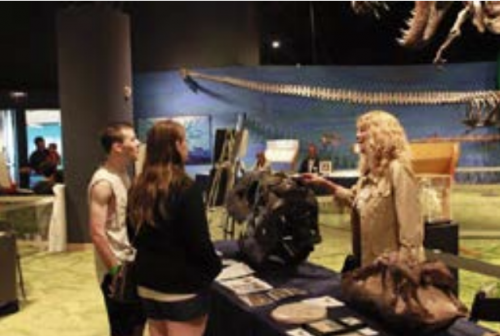
About three weeks later, we received notification that the paleontology outreach & education grant proposal jointly written by Eleanor Gardner of FOSSIL and Cindy Lockner, Bonnie Cronin, and Russell Brown of the Florida Fossil Hunters was funded by the Paleontological Society. This grant will improve the reach of the next Women in Paleontology Day by (1) securing either in-person or virtual-based talks from a more racially diverse population of female paleontologists; (2) adding Girl Scout badge-earning activities as part of the event; and (3) facilitating girls’ participation in the National Park Service’s “Junior Paleontologist Program.” Funding from the Paleontological Society will be used to help underprivileged girls attend the program.
FOSSIL team members continue to give talks to local fossil clubs. On May 7, Ronny Leder gave a talk entitled “New Techniques for the Classification of Shark Teeth (and the benefits of big database research and digitization of fossils)” at the Tampa Bay Fossil Club, and on May 14 Victor Perez spoke to the Southwest Florida Fossil Society about his research on fossil sharks and rays of Panama. Victor also received the society’s Mitchell Hope scholarship.
On Friday May 27 and Saturday, May 28, Bruce MacFadden (FOSSIL Project director) represented FOSSIL at the Aurora Fossil Festival in North Carolina. He first joined many members of fossil clubs in the pre-meeting trip to Belgrade fossil quarry, which has yielded many interesting Cenozoic fossils and continues to be a focal point before the festival. On Saturday, Bruce staffed the FOSSIL display table next to the Smithsonian’s table and helped to identify fossils as well as help with turtle shell anatomy to participants.
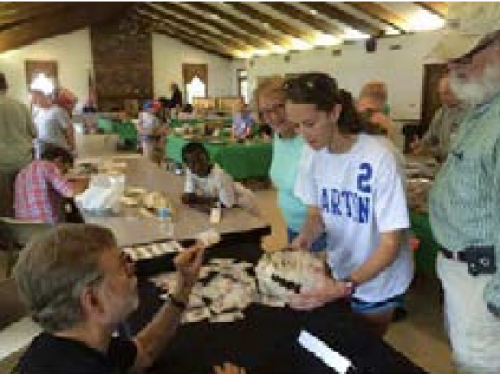
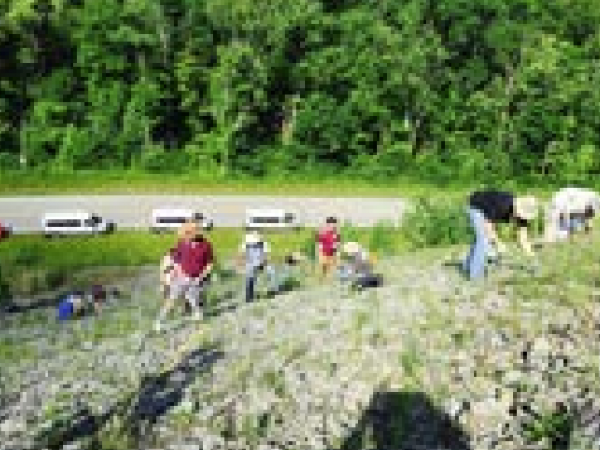
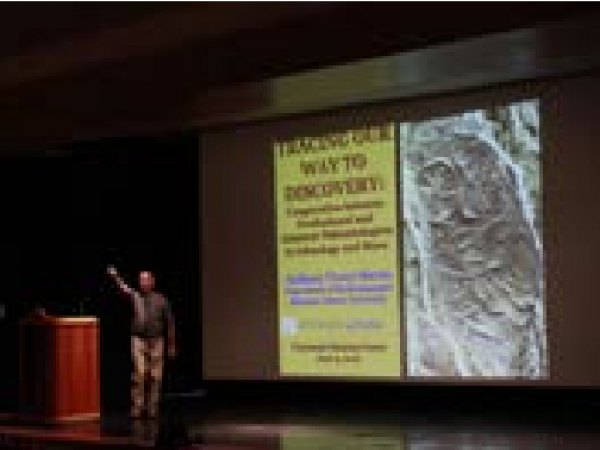
Each year, the FOSSIL Project sponsors a meeting to bring together folks involved in this project and highlight a fossil club or society. This year, the FOSSIL/Dry Dredgers Cincinnati Mini Conference on Paleontology, held June 2-5, was a huge success. Over 80 attendees from across the country participated in the mini conference, with representatives from 12 different fossil clubs, professors and students from 12 different colleges/universities, teachers from 7 different K-12 schools, and professionals from several local museums and government offices. The day-long field trips on Friday and Sunday were outstanding, as were the keynote talk on Friday night by Tony Martin on trace fossils and the mini conference events on Saturday. The townhall discussion on Saturday evening, with Arnie Miller and Steve Holland of the Paleontological Society, generated lots of great ideas about enhanced professional and amateur engagement. To read a more detailed summary of the Cincinnati Mini Conference, please see the Special Bulletin from the Dry Dredgers, reproduced in this newsletter.
 Exploring a Cincinnatian outcrop for Paleozoic Fossils
- Tony Martin’s Keynote Talk
- Attendees participating in the ‘Biostratinomy and Taphonomy’ breakout session
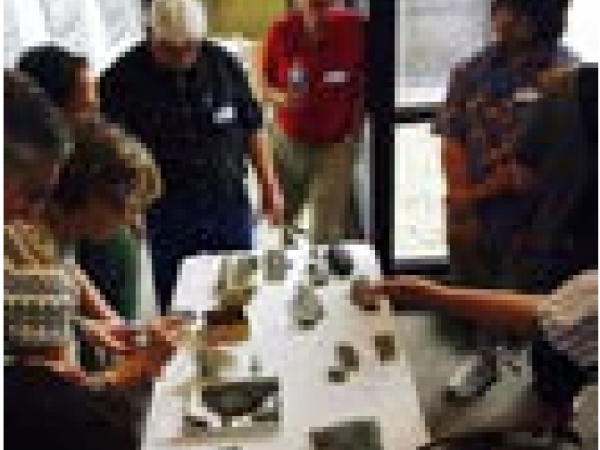
Days after the FOSSIL team returned from Cincinnati, on June 7 and 8, FOSSIL team members Bruce MacFadden, Victor Perez, and Lisa Lundgren, plus UF graduate student Sean Moran, led a professional development workshop on using fossils in the classroom. Sixty elementary school teachers from Palm Beach County, Florida, were provided with kits of local fossils to take back with them. Related to the search for fossils for K-12 kits, on June 23rd, Bruce received a donation of eight redwood leaf fossils from Aaron Currier, president of the North America Research Group in Oregon, during a STEM teacher workshop and fossil dig in Gainesville, Florida, sponsored by our sister project PCP-PIRE/GABI-RET. Several other fossil clubs were represented at this workshop, including the Western Interior Paleontological Society, the Dallas Paleontological Society, and the Fossil Club of Lee County.
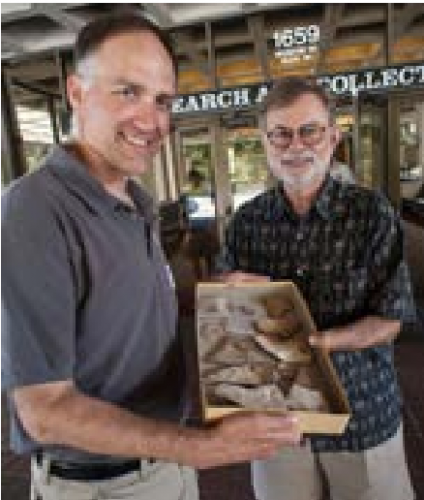
On Friday June 17, Bruce visited the Smithsonian fossil vertebrate collections. There he worked with Fred Grady, retired paleontologist from the U. S. National Museum, on fossils from Belgrade, North Carolina. Each year new taxa are added by discoveries and donations and we are approaching a point where a distinct fauna of early Miocene land mammals is coming together. The Belgrade collection now has diagnostic land mammals, including the pig-like entelodont (big tooth in upper left of photo), which indicates an Arikareean land mammal age, about 20 million years old. Arikareean-age mammals take their name from the Arikaree Group sediments and fossils from western Nebraska, and these animals are also known as far north as Canada and as far south as Panama. We would like to publish a paper on the Belgrade fossil mammals, and therefore are interested in learning about additional fossil land mammals that might be in private collections.
Recent FOSSIL publications
MacFadden, B. J., Lundgren, L.M., Dunckel, B.A., Ellis, S., and Crippen., K. 2016. Amateur paleontological societies and fossil clubs, interactions with professional paleontologists, and the rise of 21st century social paleontology in the United States. Palaeontologia Electronica, 19.2.1E. (Open access)
Crippen, K.J., Ellis, S., Dunckel, B.A., Hendy, A.J.W., and MacFadden, B. J. 2016. Seeking shared practice: A juxtaposition of the attributes and activities of organized fossil groups with those of professional paleontology. Journal of Science Education and Technology, 10.1007/s10956-016-9627-3.