Recent activities
The FOSSIL Project collaborated with the Dallas Paleontological Society (DPS) and held a successful two-day mini conference October 12 -13, 2015, prior to the Society of Vertebrate Paleontology (SVP) meeting. The mini conference included: a tour of the paleontology collections at Southern Methodist University; informative talks; a town-hall style forum with presentations by Dr. Scott Foss (Bureau of Land Management Senior Paleontologist), Linda McCall (North Carolina Fossil Club President), and Cynthia Crane (Aurora Fossil Museum Director); a well-attended and inspiring keynote talk on bird origins by Dr. Paul Sereno of the University of Chicago; and a day-long field trip to fossil localities in the greater Dallas area. We thank Rocky Manning, Lee Higginbotham, and the other members of the host/planning committee for an excellent time. After the mini conference, many of us then attended the SVP meeting in downtown Dallas, which included more than 1,000 professional and amateur paleontologists as well as students from the U.S. and around the world.
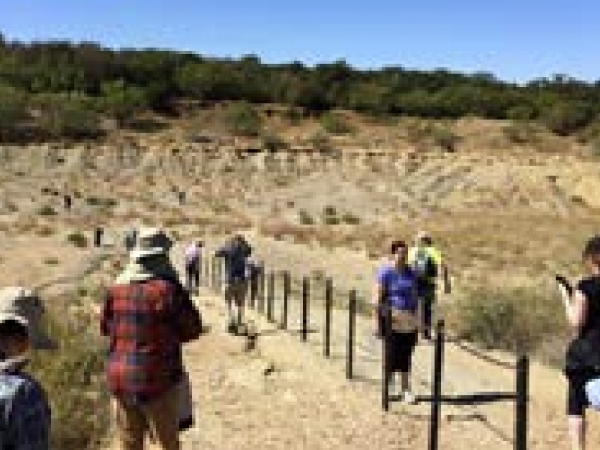
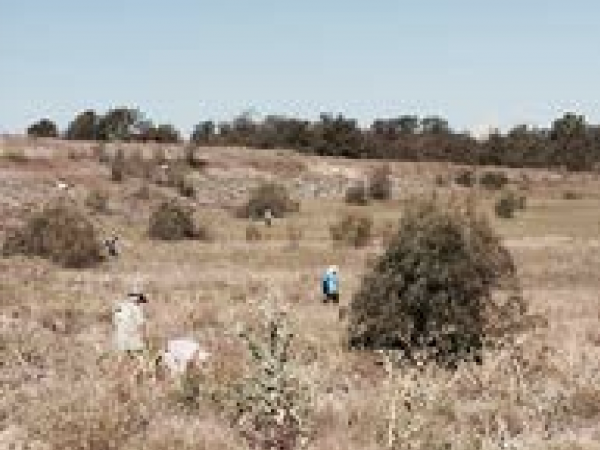
 Mineral Wells (DPS Trip)
- Jacksboro Field Site (DPS Trip)
Immediately after the Dallas mini conference, Lisa Lundgren, a PhD student in Science Education at the University of Florida and the FOSSIL Project’s social media manager, presented research at the e-Learn international conference in Kona, Hawaii. The annual e-Learn conference features research from the fields of government, health care, and higher education. Lisa presented two papers on FOSSIL Project-related research (see Products section below). The first paper was an explanation of how we created the myFOSSIL community website. The second paper was an exploration of a newly developed framework for understanding peoples’ “mental models” of social media. Lisa reported that the conference was a great opportunity to see new research presentations and make connections with researchers from around the world.
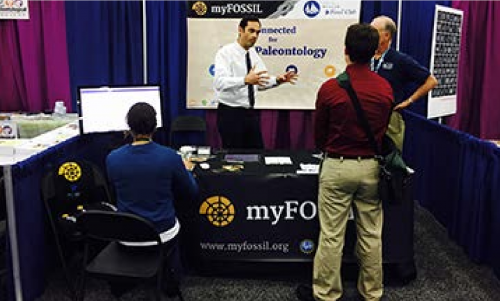
In early November, the FOSSIL Project hosted an exhibit booth at the annual Geological Society of America (GSA) meeting in Baltimore, which was attended by more than 5,000 geologists, paleontologists, students, and educators. Our booth showcased the new myFOSSIL community website and our partnerships with local fossil clubs – in this case, the Calvert Marine Museum Fossil Club. Thanks go out to Dr. Stephen Godfrey (museum curator) and, in particular, Mike Ellwood (club president) for engaging visitors with fossils from the famous Calvert Cliffs locality. It was great to interact with so many interesting professionals, students, and amateurs at our booth – and we hope they all will become members of the myFOSSIL community!
During the meeting’s technical sessions of presentations, Bruce MacFadden and Lisa Lundgren spoke, respectively, about the FOSSIL Project’s role in fossil data digitization and using social media as a tool to measure FOSSIL community engagement. Victor Perez also gave a talk related to his paleontological research on sharks from Panama, and Ronny Leder presented a poster on the interaction between the FOSSIL Project and the iDigBio Project. Other individuals affiliated with the FOSSIL Project, including Dr. Benjamin Dattilo (professional paleontologist and Dry Dredgers member) and Linda McCall (president of the North Carolina Fossil Club) gave talks at the meeting as well.
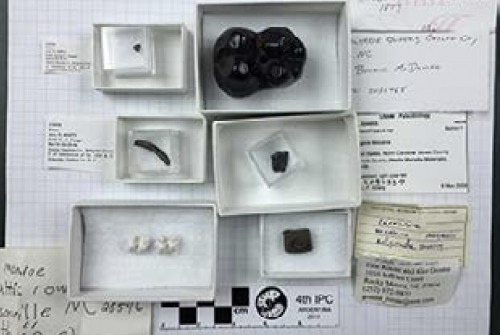
Later in November, Bruce MacFadden visited the vertebrate paleontology collections at the U.S. National Museum, Smithsonian Institution in Washington, D.C. He had the opportunity to talk with David Bohaska and study the rare fossil mammals from the early Miocene Belgrade Quarry in eastern North Carolina. These land mammals fill a gap in our knowledge from a very interesting region between what is known of fossils from similar age in Delaware and the well-known Thomas Farm quarry in Florida.
Also in November, Eleanor Gardner presented a talk entitled “Preservation Bias in the Avian Fossil Record: A Taphonomic Viewpoint” at the Fossil Club of Lee County in Fort Myers, FL. The talk was very well attended and lots of great questions were asked by club members. Eleanor and Lisa Lundgren hosted a fossil activity table at the Florida Museum of Natural History’s “She’s A Scientist” Girl Scout exploration event; scouts completed three requirements toward earning an earth-science-related badge. Additionally in November, the FOSSIL Project helped sponsor a talk by Dr. Sandra Carlson (University of California-Davis) at the monthly meeting of the Friends of the University of Michigan Museum of Paleontology in Ann Arbor, MI. Back in October, Victor Perez gave a research talk at the Florida Fossil Hunters’ monthly meeting in Orlando; while Ronny Leder traveled to Rochester, NY, to meet with the Rochester Academy of Science Fossil Section group.
myFOSSIL launch
After more than a year and a half of development and testing, we launched the myFOSSIL website during the Dallas mini conference in October. The website is intended to be the go-to place for social paleontology and offers many opportunities to connect to friends, upload fossil images and associated data, explore and add to a calendar of events, participate in discussion forums (including the “What Is It?” fossil ID forum), and access resources. Since the launch, we have steadily increased the number of users; we now have over 120 members, which represents more than a doubling since the launch. We are excited that, in addition to members of fossil clubs and professional paleontologists, we have started to see others visit the myFOSSIL community and participate, including students, independent amateurs (i.e., not affiliated with a society or club), and K-12 teachers.
We also thank the many participants who provided feedback during the testing phase that helped us streamline and optimize the usability of myFOSSIL. If you want to understand the pulse of the amateur and professional interactions on a national level, we hope that you will join in the discussions and activities promoted on myFOSSIL. We are excited about the success of myFOSSIL so far and look forward with optimism to seeing its growth and ability to serve interested audiences. As the FOSSIL Project continues to mature, we envision an increasing emphasis on the myFOSSIL website to sustain the community of social paleontologists that we have built together.
Products
The FOSSIL team recently published two articles in the peer-reviewed literature on using social media in informal education (see full citations below). For a complete list of presentations and publications by the entire FOSSIL community–both by team members and affiliated amateurs–please explore the list on our website.
Crippen, K., Dunckel, B., MacFadden, B., Ellis, S. & Lundgren, L. (2015). A Framework for Social Paleontology via an Online Community Space. In Proceedings of E-Learn: World Conference on E-Learning in Corporate, Government, Healthcare, and Higher Education 2015 (pp. 305-311). Chesapeake, VA: Association for the Advancement of Computing in Education (AACE).
Lundgren, L. & Crippen, K. (2015). Designing for Social Paleontology: An Exploratory Study of Citizen Mental Models. In Proceedings of E-Learn: World Conference on E-Learning in Corporate, Government, Healthcare, and Higher Education 2015 (pp. 849-858). Chesapeake, VA: Association for the Advancement of Computing in Education (AACE).