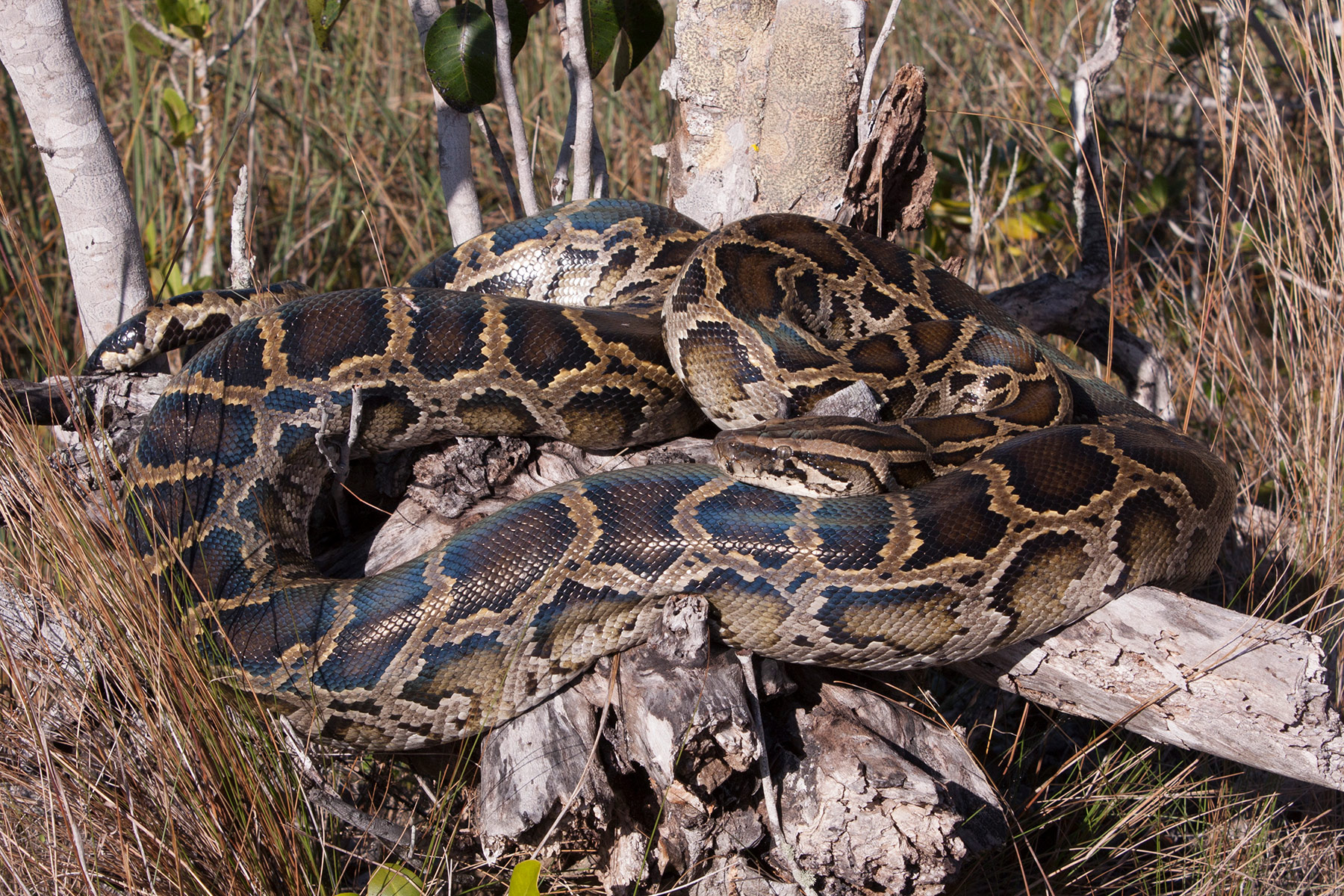
Most adult Burmese Pythons are about 10-16 feet (3-5 m) in total length. These are very large, stout-bodied snakes with dark brown blotches down the back and sides. The blotches are variable in size and shape, and they are bordered in black. The background coloration between the blotches is usually tan, tannish yellow, or cream colored. The top of the head is dark with a light stripe on both sides of the head that extends through the eye to converge on the nose, forming a dark V-pattern. Juvenile color pattern is similar to that of adults, except the coloration is more vivid.
Burmese Python. Photo courtesy of Todd Pierson.
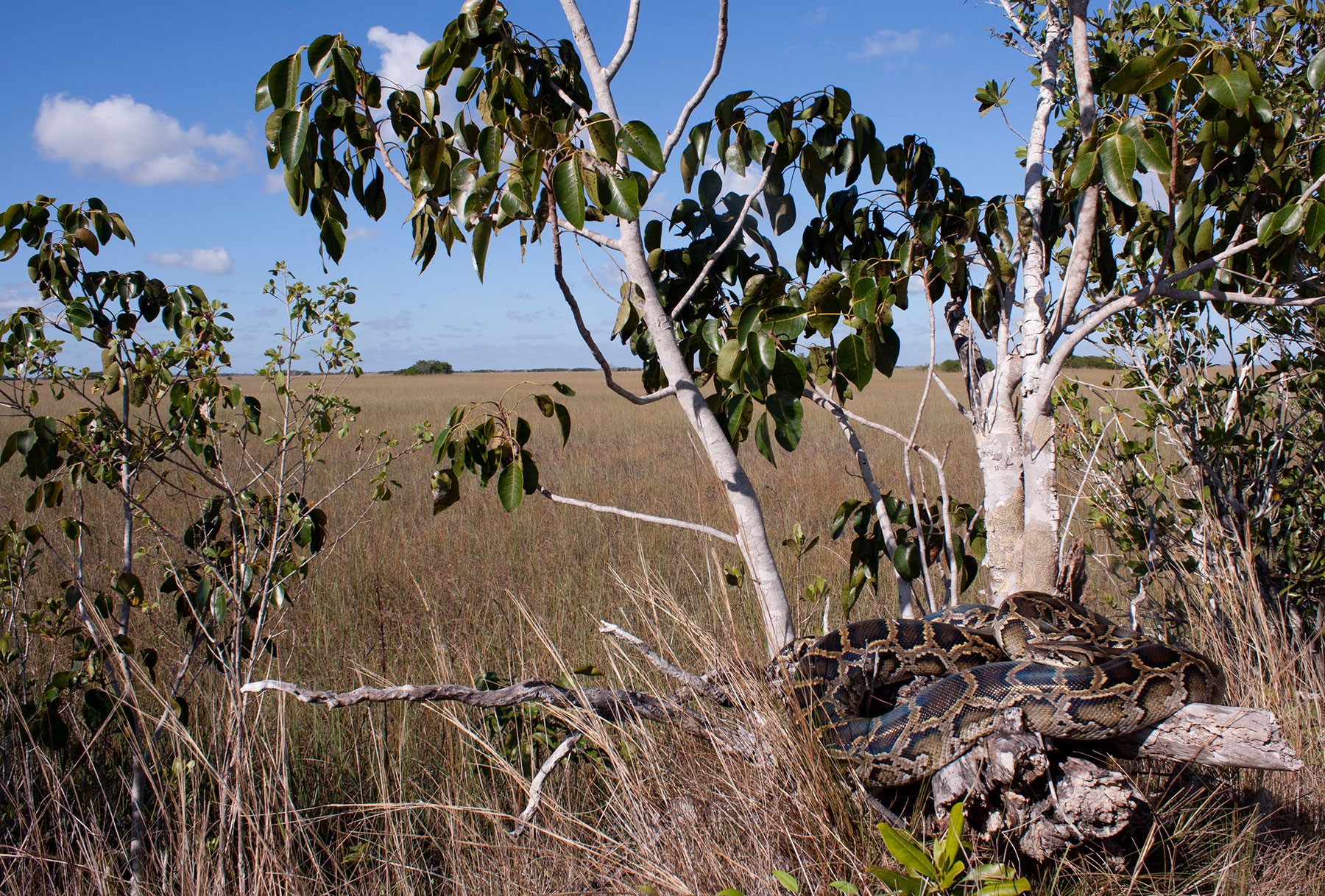
Burmese Python in its habitat. Photo courtesy of Todd Pierson.
Range in Florida
Burmese Pythons are a non-native species from southern and southeastern Asia that have been established in Florida since the 1980s. They have been introduced in numerous areas in Florida. However, they are currently known to be established only in the southern Florida peninsula from Lake Okeechobee south to Key Largo and Florida Bay. The Everglades National Park remains a stronghold for this species.
Assessment of risk to people and pets
Non-venomous. Burmese Pythons may bite to defend themselves. Small individuals are not generally dangerous to people or pets. However, larger Burmese Pythons have large, sharp teeth, and their bites can cause severe lacerations. Large animals are also fully capable of eating dogs and cats. Virtually all bites occur when the snakes are intentionally bothered.
Comparison with other species
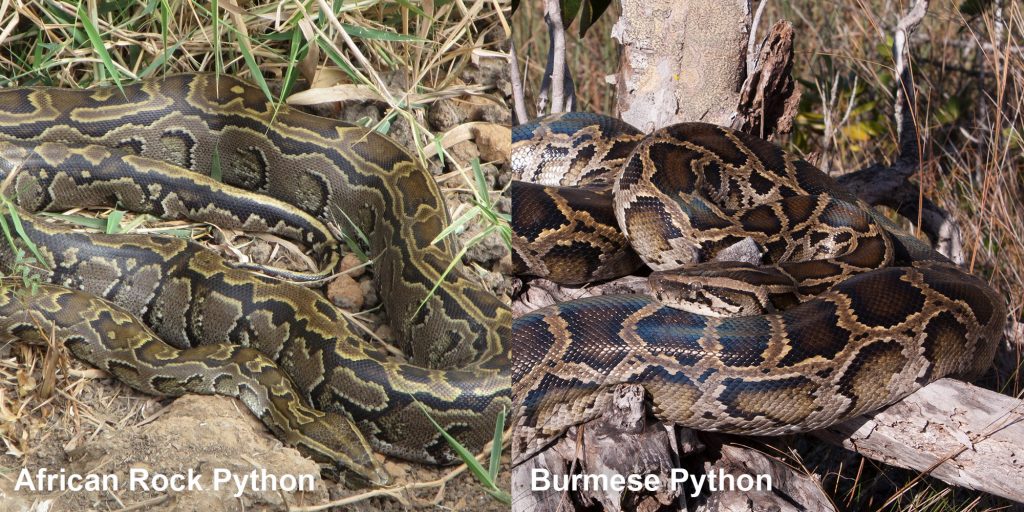
African Rock Python (Python sebae) Non-venomous Northern African Rock Pythons have two mostly continuous and irregular dark blotches down the back that are bordered by black and white.
African Rock Python. Photo courtesy of lucykeith-diagne/iNaturalist Burmese Python. Photo courtesy of Todd Pierson.
Most adult Burmese Pythons are about 10-16 feet (3-5 m) in total length, with a record length in Florida recorded of 16.8 feet (5.12 m). These are very large, stout-bodied snakes with dark brown blotches down the back and sides. The blotches are variable in size and shape, and they are bordered in black. The background coloration between the blotches is usually tan, tannish yellow, or cream colored. The belly is light-colored and unmarked in the center with dark spots along the sides. The top of the head is dark with a light stripe on both sides of the head that extends through the eye to converge on the nose, forming a dark spearhead pattern. A second light stripe extends diagonally from the corner of the mouth to the eye. The scales on the body are smooth. The pupil is vertically elliptical (cat-like). There are deep facial pits between the scales along front of the upper lip. Juvenile color pattern is similar to that of adults, except the coloration is more vivid.
In Florida, Burmese Pythons have been found in and around undeveloped seasonally flooded wetlands (e.g., the Florida Everglades), tree islands, hardwood hammocks, prairies, mangrove salt marshes, melaleuca and Brazilian pepper stands, agricultural areas, man-made canals and lakes, and housing developments.
Burmese Pythons typically remain well hidden in dense vegetation to avoid detection. However, if they are cornered, both juveniles and adults may quickly strike at the attacker. If grabbed or pinned, they may bite the attacker and hold on while writhing and constricting. Nonetheless, these snakes are not aggressive, and striking is only used in defense as a last resort.
Burmese Pythons primarily feed on a wide range of mammals (including deer) and birds, but they will occasionally eat alligators. These snakes are powerful constrictors.
In Florida, females lay 11-87 white eggs, which hatch between June and August. Females remain coiled around the eggs without eating until they hatch about two months later. Hatchlings average 26 inches (65 cm) in total length.
Burmese Pythons (Python bivittatus) were considered a subspecies of the Indian Python (Python molurus) up until 2009. The decision to elevate the subspecies to distinct species appears to be widely but not universally accepted.
The deep facial pits between the scales on the upper lips of Burmese Pythons are sophisticated heat-sensitive organs that allow these snakes to sense the heat emitted by endothermic (warm-blooded) prey even in complete darkness. This extra sense helps these snakes to be highly effective nighttime predators.
Burmese Pythons are having a profoundly negative ecological impact in areas where they have been established the longest. One study published in 2012 reported that raccoon, opossum and bobcat populations in remote parts of Everglades National Park have declined by 99.3, 98.9, and 87.5 percent, respectively. The same study noted that marsh rabbits, cottontail rabbits, and foxes had effectively disappeared from these areas.
Burmese Pythons were listed as an injurious species in 2012 by the U.S. Fish and Wildlife Service. This listing prevents the importation of this species into the United States except for zoological, educational, medical, or scientific purposes and only with a permit.
If you have a new or interesting observation for this species, please email the herpetology staff at the Florida Museum.
Dorcas, M.E., J.D. Willson, R.N. Reed, R.W. Snow, M.R. Rochford, M.A. Miller, W.E. Meshaka, Jr., P.T. Andreadis, F.J. Mazzotti, C.M. Romagosa, and K.M. Hart. 2012. Severe mammal declines coincide with proliferation of invasive Burmese pythons in Everglades National Park. PNAS 109: 2418-2422.
Jacobs, H.J., M. Auliya, and W. Böhme. 2009. Zur taxonomie des dunklen tigerpythons, Python molurus bivittatus Kuhl, 1820, speziell der population von Sulawesi. Sauria 31(3): 5-16.
Krysko, K.L., K.M. Enge, and P.E. Moler. 2019. Amphibians and Reptiles of Florida. University of Florida Press, Gainesville, Florida. 706 pp.
Powell, R., R. Conant, and J.T. Collins. 2016. Peterson Field Guide to Reptiles and Amphibians of Eastern and Central North America. Fourth edition. Houghton Mifflin Harcourt Publishing Company, Boston and New York. xiv + 494 pp.
Still have questions about snakes or identifications? Feel free to email the herpetology staff at the Florida Museum with your questions or feedback on this profile.
Banner photo courtesy of Todd Pierson. Please credit any photographers on the page and see our copyright policy.